The Ambassador Recruitment Done Right

A client of mine recently launched their ambassador program with a single email: "Become an ambassador. Earn rewards." It went to their entire customer base. The open rate was OK but the CTR was terrible. The sign-ups? A handful out of 3.5K audience. Way less than our usual 5% to 10% signup rate our clients have.
They asked me what went wrong. The email was well-written. The rewards were real. The design was on-brand. They had the feeling they put the effort into it.
What went wrong then? It was a transactional invitation to join something that didn't exist yet in the mind of the people :
- No one had talked about the community before.
- No one had shown what being an ambassador actually looked like.
- The recipient had signup for an undefined role, in an invisible group, for a vague upside.
That's not a recruitment email. That's a cold cold-call with extra steps.
What you're actually selling
When you recruit community members, ambassadors, you're not selling a task in exchange for a reward. That framing is the first mistake, and it's the one most program managers make.
If all you offer is "do these things, get these points, redeem this swag," you've built a micro-gig economy. It's disguised unpaid work, and you’re missing your best potential ambassadors. The people who accept are the ones who were going to help you anyway — you didn't recruit them, you just gave them a button to press.
What actually pulls people in is harder to put on a message (mail, landing page…) but much more powerful: status, community, and experience. Rewards matter, but they're the cherry. They're not the cake.
Exemple of three things that actually pull people in
Here are the three things that, in my experience, make a prospective community member lean in — and concrete examples of what they look like.
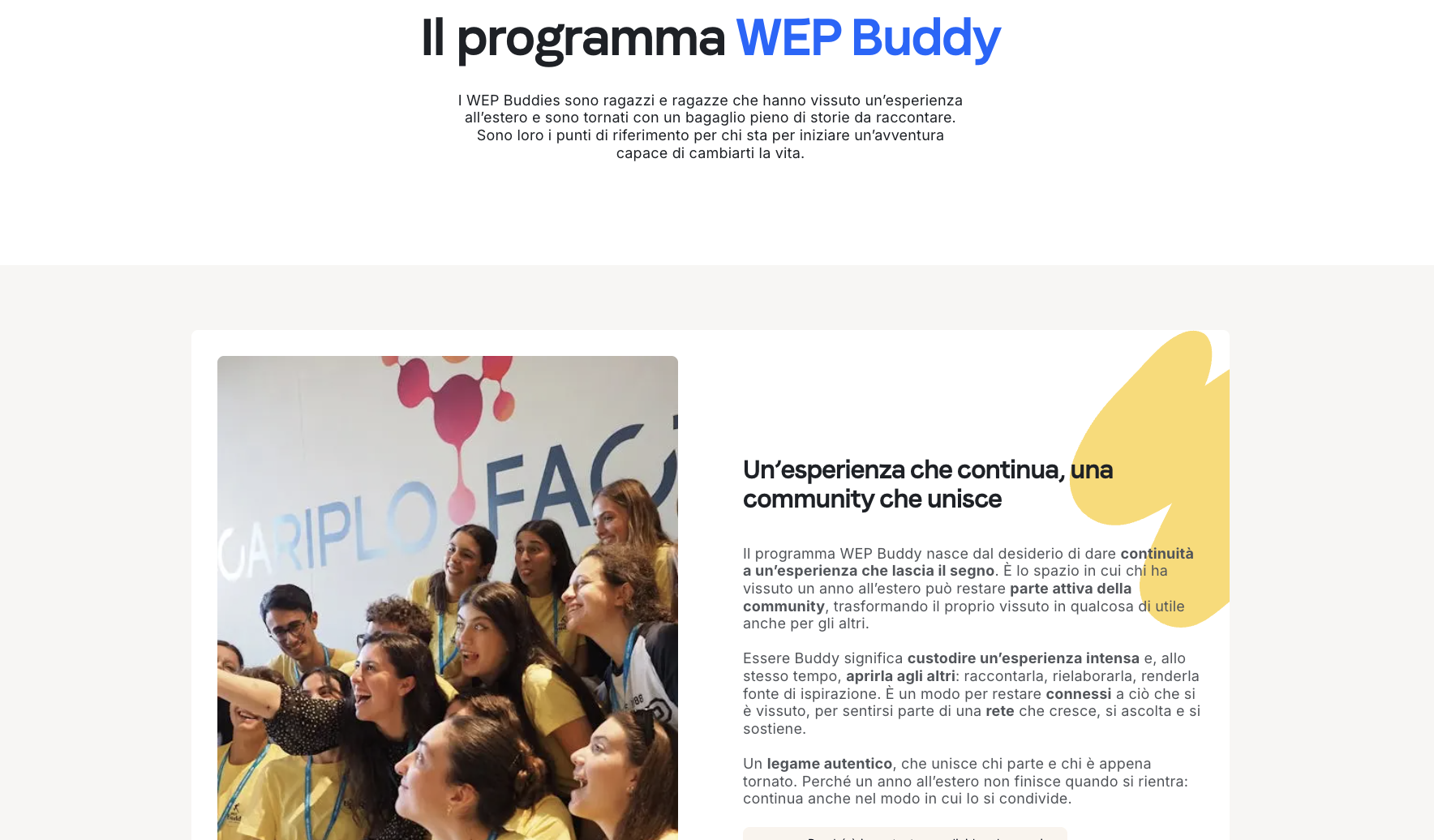
Status. Being an ambassador has to mean something. A title, a role, a visible marker that says: this person has done something others haven't. WEP, the Italian study-abroad operator, calls their returning students "WEP Buddies" and describes them as "points of reference" for the next generation of exchange students. That's status made concrete. It's not a badge on a profile page — it's a role with a name and a purpose. When someone reads that page, they don't think "I could earn rewards." They think "I could be that."
Community. Nobody wants to join an empty room. The pitch has to show the network the prospective ambassador is entering — who else is there, what they're like, how they connect. The WEP page does this with a simple framing: "Join the WEP Tribe." One word — Tribe — and you immediately picture a group, not a form. Compare that to "Sign up to our ambassador program" and you see the gap. People join people. They don't join programs.
Experience. This is the one most programs forget. What will I actually live, week by week, as an ambassador? What will I do, who will I meet, what will I take away? The experience isn't the perks — it's the days, the conversations, the moments. If you can't describe that, your candidates can't picture themselves in it. And if they can't picture it, they don't sign up.
Of course rewards matter but they come last. They work when they reinforce the other three rather than replace them. For exemple: A hoodie that only ambassadors get is a perk and a status marker at the same time. A 50€ voucher for every friend referred is a transaction. The first builds identity; the second should always be in contact with a thank you message to support experience.
If you lead with Status, Community, and Experience, the perks become a nice reinforcement of a decision already made.
The Belonging Flywheel: how to put the three things in motion
We got the three pillars now what? You have to sequence them. Status, Community, and Experience don't appear because you list them on a landing page — they have to be built, and built in the right order.
I call this sequence the Belonging Flywheel. It's borrowed in spirit from community organisers — Saul Alinsky's rule about starting with the people already active in a neighbourhood rather than the ones you wish were active. You don't manufacture a community. You identify the energy that already exists and give it a shape.
The flywheel has four stages. Each one feeds the next. We’ve actually tested it with WEP.
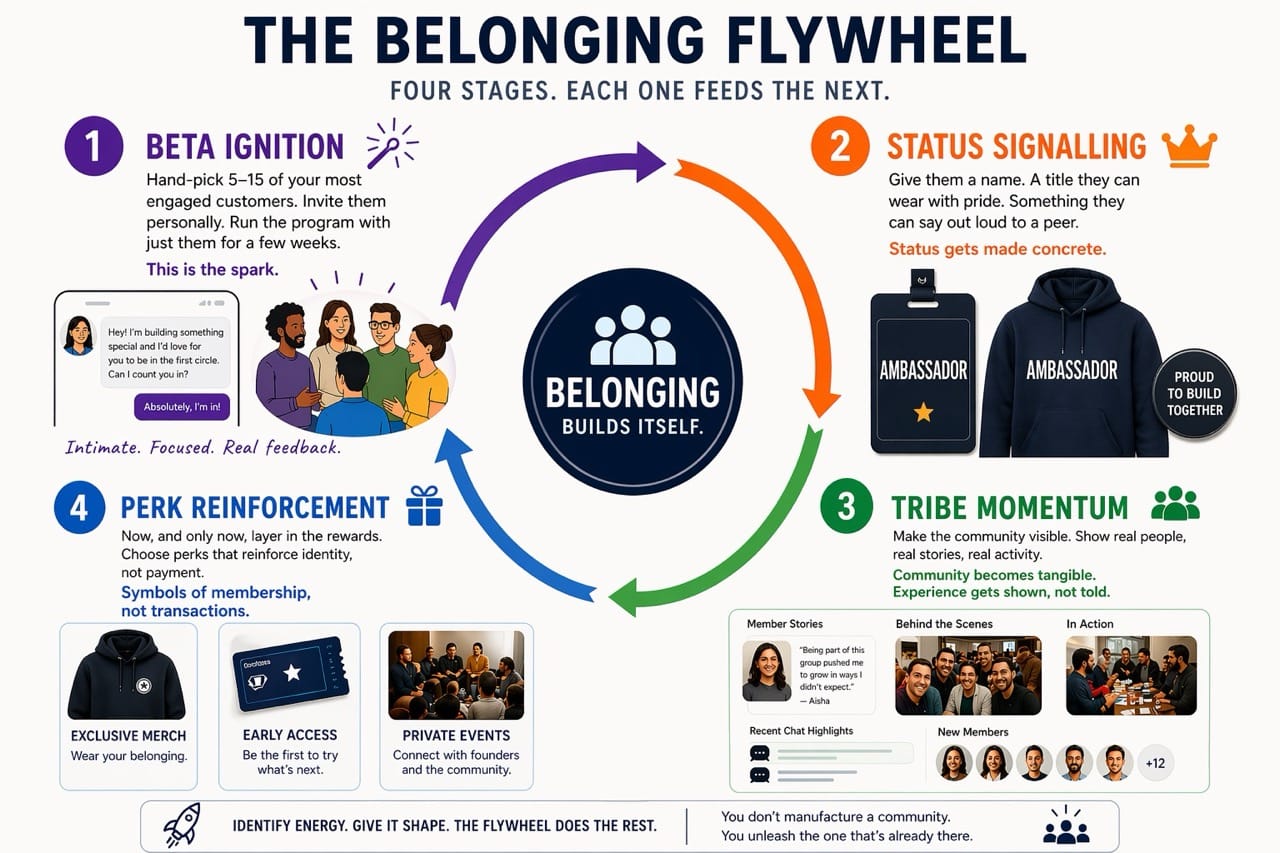
1. Beta ignition. Hand-pick five to fifteen of your most engaged customers. The ones that you already know (reply to your posts, use every feature, recommend you to peers). Invite them personally — call them, don't email-blast them. Tell them you're building something and you want them in the first circle. Run the program with just them for few weeks. This is the spark. Just immediate activity where you get feedback and polish processes.
2. Status signalling. Give them a name. WEP Buddies, Founding Ambassadors, Trailblazers — whatever fits your brand, but it has to be a title they can wear with pride. Something they can say out loud to a peer. This is where the first of the three things — status — gets made concrete. A badge on a profile doesn't do this. A public, named role does.
3. Tribe momentum. Make the community visible. A page where you share testimonials from your beta group, screenshots of the private chat, photos from meetups, stories of what members did. New ambassadors arriving on your page don't see a program — they see a group already in motion, with faces and names. This is where the second of the three things — community — stops being a word on the page and becomes tangible. And it's where the third — experience — gets shown rather than told. People see what being an ambassador actually looks like.
4. Perk reinforcement. Now, and only now, layer in the rewards. And choose them carefully: perks that reinforce identity (an exclusive hoodie, early product access, a private event with the founders) rather than perks that feel like payment for services rendered (points, vouchers, discounts). The first kind become symbols of membership.
The loop closes here: the beta members, now carrying a title and genuinely enjoying what they get, start referring peers. Those peers enter the community with welcomes from beta members. The flywheel turns again, faster this time, because the tribe is already visible from the outside. More members → stronger status → more visible tribe → better perks to share → more referrals back into ignition.
That's the difference between a program that fizzles after the launch email and a program that compounds.
A cautionary tale: when you name it a community without building one
Take Lululemon's Sweat Collective. The name does half the work — Collective signals group, Sweat signals identity. Eligibility is strict: you have to be a fitness instructor, a coach, an athlete at national level. That rarity produces real status. So far so good.
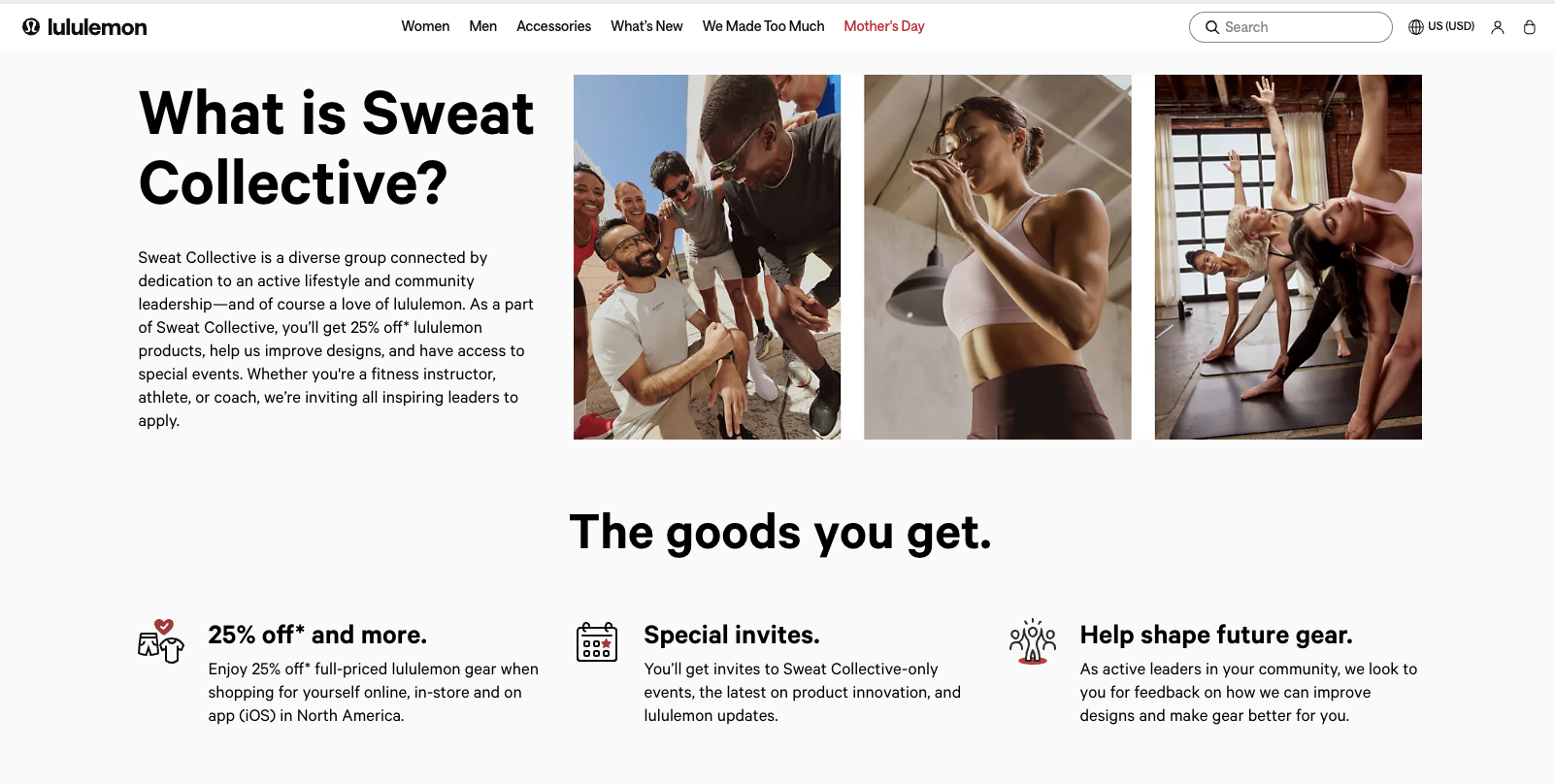
But open the page and look closer. The promises, in order, are: 25% off, special invites, help shape future gear. Rewards come first. The community itself is invisible — no faces, no testimonials, no photos of events. The word Collective sits on the page with nothing to back it up. And the mechanisms to "shape future gear" are never shown: no forum, no panel, no process. Just a promise.
The result is a well-branded discount program dressed as a community. It probably works for Lululemon — discounted professionals stay loyal and wear the gear in studios. But it misses the flywheel entirely. The Collective never becomes visible, so it never compounds. Each new member arrives at the same empty room as the one before them.
The lesson: if you put the word community, tribe, or collective in your program name, you've made a promise. The page has to deliver it — with faces, names, stories, and a visible loop. Otherwise the name becomes a tell. The more ambitious the label, the more the gap shows.
Stop selling rewards. Start offering a place to belong.
The programs that work aren't the ones with the best point systems. They're the ones where the role has a name, the community has a face, and the new ambassador arrives somewhere that's already alive.
Status, community, and experience — sequenced properly — will get you advocates.